
Transform the future of your business!
Let’s turn your challenges into opportunities. Get in touch with our friendly team, and learn how ddroidd can help your organisation evolve.
Contact us

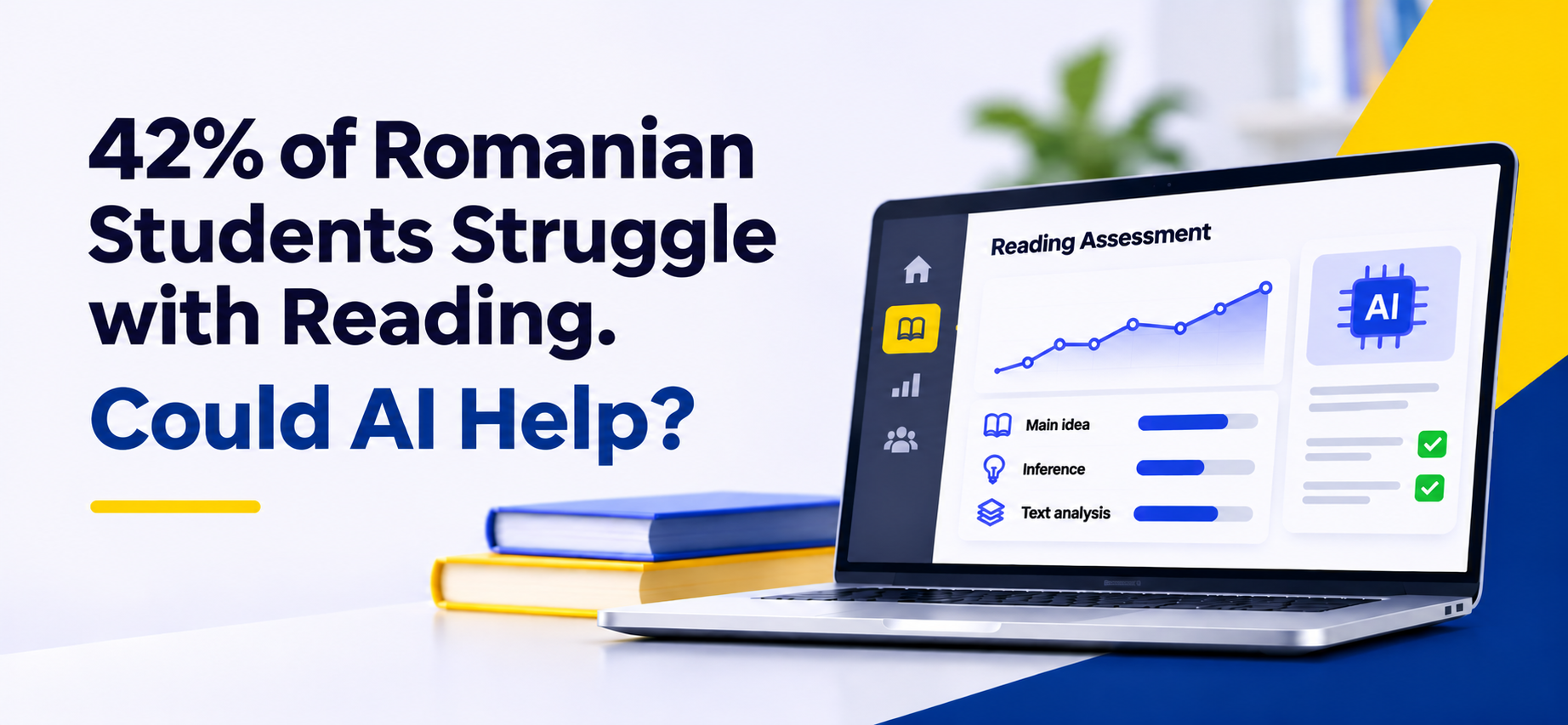
Romania faces a serious literacy challenge. While AI cannot solve it alone, it could help educators identify learning difficulties earlier and provide more targeted support.
According to the OECD's PISA 2022 results, 42% of Romanian 15-year-olds performed below the minimum proficiency level in reading, compared with an OECD average of 26%.
That means almost one in two students struggle with essential skills such as understanding the main idea of a text, identifying relevant information or interpreting what they read.
The consequences extend beyond the classroom. Reading comprehension influences how people evaluate information, make decisions and develop new skills throughout their lives.
Romania has been discussing this challenge for years. But what if schools could identify where students begin to struggle, rather than waiting until their results show they have already fallen behind?
Consider a classroom of 25 students.
Some understand a text immediately. Others struggle to identify its main idea, draw conclusions or distinguish facts from opinions.
Traditional assessments can measure performance, but similar scores don't always reflect similar learning needs.
AI-supported assessment platforms could help educators understand those differences.
By analysing responses and identifying patterns, these systems could provide more detailed information about individual reading competencies, recommend relevant learning materials and track progress over time.
The goal isn't to replace teachers or automate their decisions. It's to give them better information, earlier, so they can provide the right support.
The opportunity extends beyond individual classrooms.
For schools, regular digital assessments could help identify learning gaps earlier and support more informed teaching decisions.
For educational publishers, connecting existing learning materials with individual competency assessments could make educational content more relevant to each student.
For public institutions, aggregated and appropriately protected assessment data could offer a clearer understanding of learning difficulties across schools and regions.
For education providers, digital platforms could make personalised learning support more accessible without removing educators from the process.
The common requirement is a technology solution designed around actual educational needs, rather than AI capabilities alone.
At ddroidd, we've been exploring this opportunity through our work with Gama Publisher on LexiScor, a digital platform designed to assess reading competencies, recommend suitable texts and monitor student progress.
The challenge goes beyond identifying whether a student struggles with reading.
It's about understanding which competencies need attention, connecting those needs with appropriate educational content and making progress visible over time.
Building a product like LexiScor means combining educational expertise with software engineering, data and AI capabilities.
And, importantly, making sure the technology works for the teachers, students and institutions using it.
AI has potential in education, but introducing technology is not the same as improving learning.
Romania's literacy challenge also involves unequal access to resources, socioeconomic differences and the support available to students.
Technology cannot address all these factors.
AI-supported assessments also require careful validation, responsible handling of student data and meaningful involvement from educators.
Ultimately, success shouldn't be measured by the number of AI features a platform offers.
It should be measured by the difference those features make.
Can teachers identify difficulties earlier? Are students improving their comprehension skills? Are educational interventions becoming more effective?
These are the questions worth answering.
At ddroidd, we believe engineering has a role in turning educational challenges into practical solutions that deliver measurable outcomes.
Whether you're an educational publisher, school network or institution exploring digital learning, ddroidd can help you turn an educational challenge into a practical, scalable solution.
Explore our work in education or get in touch with our team.
Let’s turn your challenges into opportunities. Get in touch with our friendly team, and learn how ddroidd can help your organisation evolve.
Contact us